
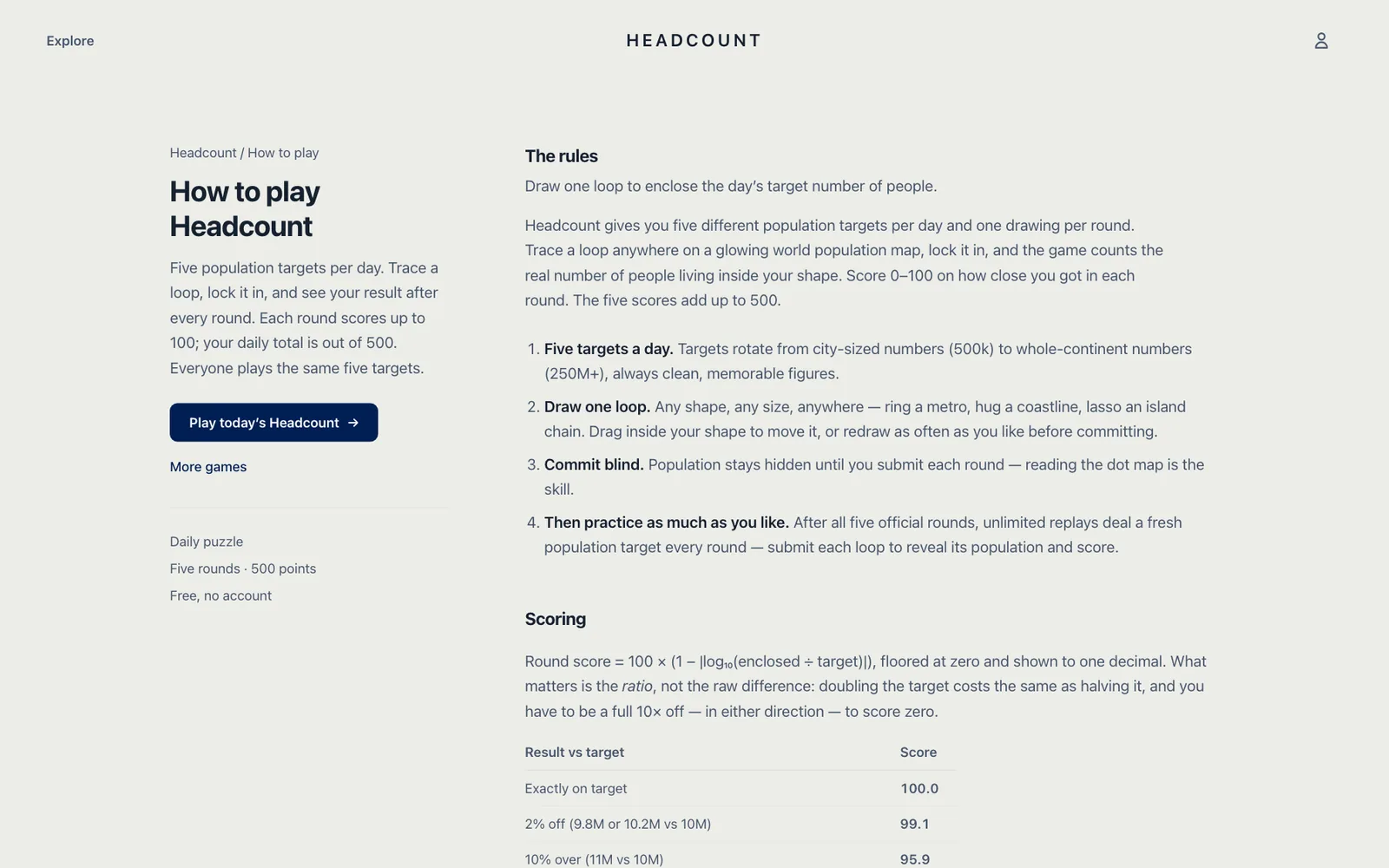
The rules, complete
- There are five targets a day. Everyone gets the same five, and they change at midnight US Eastern time.
- Each target gets one loop. You can redraw or move it until you submit; after that the round is locked.
- You do not see any population count while drawing. The number appears only after you lock in.
- Any closed shape counts. Long thin loops along a coast or river are allowed and often the best answer.
- After the five official rounds you can keep playing practice rounds; each one deals a fresh target and is scored the same way.
The scoring formula, with numbers
Score = 100 × (1 − |log10(people in loop ÷ target)|), floored at 0, one decimal
Because the formula works on the ratio, the penalty is symmetric: 20 million against a 10 million target costs exactly what 5 million costs. Small misses are cheap — the curve is flat near the target — and big misses are brutal. Below is FlightQ’s own example set for a 10,000,000 target, which I recomputed line by line from the formula; every row matches.
| Your loop holds | vs target | Round score |
|---|---|---|
| 10,000,000 | Exact | 100.0 |
| 9,800,000 | 2% off | 99.1 |
| 11,000,000 | 10% over | 95.9 |
| 12,500,000 | 25% over | 90.3 |
| 20,000,000 | Double (or half) | 69.9 |
| 40,000,000 | Four times | 39.8 |
| 100,000,000 | Ten times | 0.0 |
The four anchors worth memorising
FlightQ suggests learning a few reference regions so you can scale every other guess from them. It publishes these four, and I list only these four rather than padding the table with metro figures that use different boundary definitions.
| Anchor | Area FlightQ means | People (FlightQ figure) | Use it for |
|---|---|---|---|
| Tokyo, Japan | Greater Tokyo | 37M | Targets in the 20–40M range |
| Cairo, Egypt | Cairo metro | 22M | Targets in the 10–25M range |
| Seoul, South Korea | Seoul capital region | 26M | Targets in the 20–40M range |
| London, United Kingdom | Greater London | 14M | Targets in the 10–25M range |
Strategy that actually moves the score
Brightness beats area
A huge loop over the Sahara or Siberia catches very few people. A small loop over the Nile valley or the Ganges plain catches tens of millions. Size your loop by how bright the dots are, not by how much map it covers.
Zoom before you draw
At world zoom, Greater Tokyo and the whole Kantō plain are one blob. Zoom in until you can see where the bright core thins out, then draw. Most big misses come from drawing at the wrong zoom level.
Scale from an anchor
For a 9,000,000 target, think “a bit more than half of greater London’s 14M” or “a share of the Cairo metro’s 22M”. For 100,000,000 think “several Tokyos” — or a dense national core like the Nile delta plus valley.
Learn from every reveal
After each round, compare what your loop held with the target and note the ratio. If you keep landing at 1.3×, your loops are consistently too generous; tighten the next one.
Common mistakes
- Following a city’s official border: the game counts people, not municipalities.
- Treating a lit-up map as “many people” everywhere: suburbs glow faintly but add up slowly.
- Huge empty loops to “catch everything” on continental targets: they still need the dense cores inside.
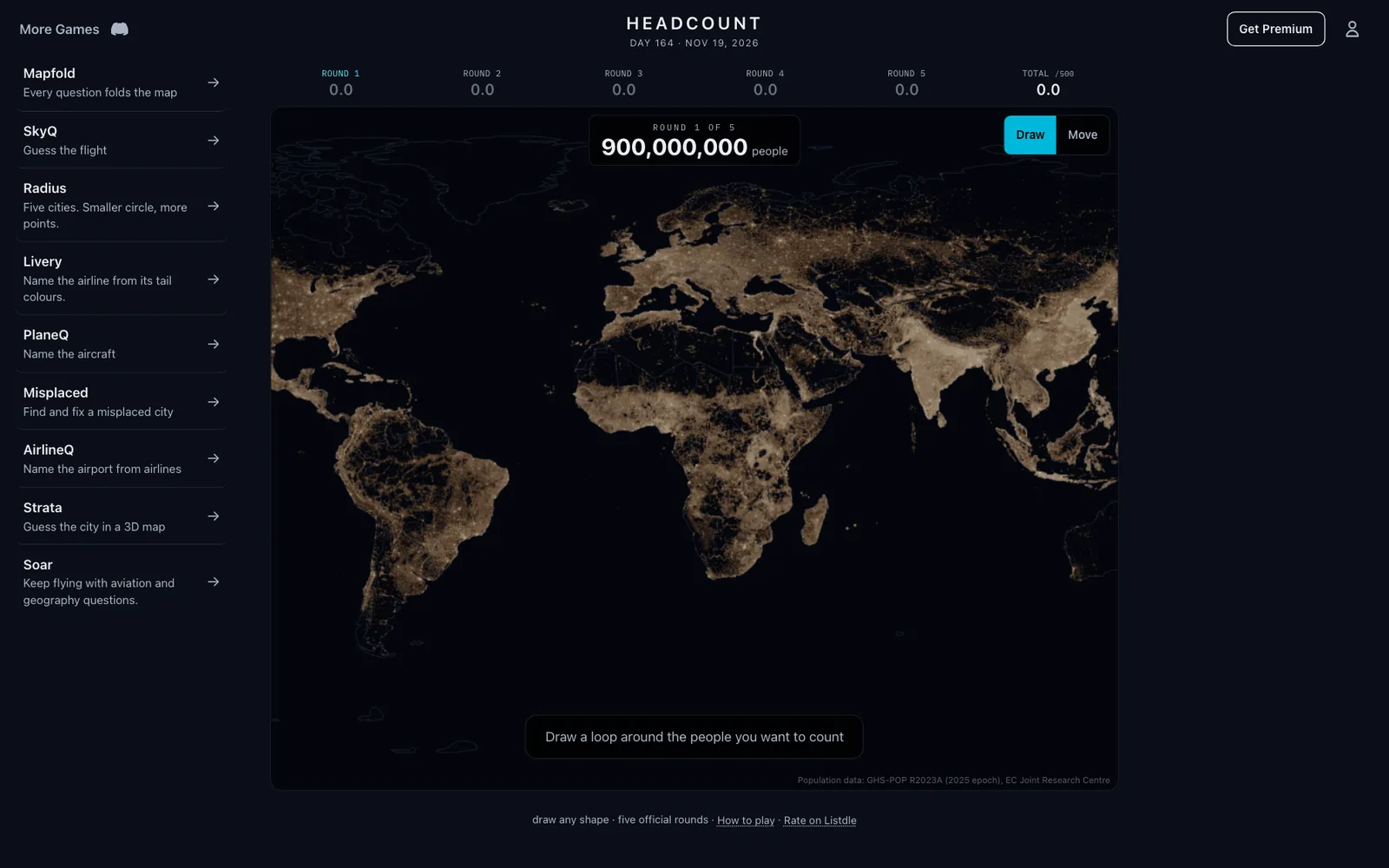
How it compares with the party game’s scoring
The party game scores five different question types out of 20 each, mostly by percentage points off the crowd. Its Backyard room is the only one close to this ratio idea. Here every round is the same question — how many people — and the log formula is the whole game.
FAQ
How does Headcount work?
You get a target number of people and draw one loop on a world population map. The game counts the people inside and scores 0–100 by how close the ratio is to 1. Five rounds make 500.
What score do I get for being double the target?
69.9 — exactly the same as being half the target, because the formula uses the logarithm of the ratio.
Is 2% off still a good score?
Yes. 2% off scores 99.1 and 10% over scores 95.9. The curve is flat near the target and steep far from it.
Does the shape of the loop matter?
Only through who it encloses. Any closed shape is allowed, so hugging a coastline or a river valley is a legitimate tactic.
Sources and check dates
- FlightQ Headcount How to Play — checked 2026-11-19
- FlightQ Headcount game page — checked 2026-11-19
- FlightQ Methodology (daily reset, scoring on the server) — checked 2026-11-19
- GHS-POP R2023A population grid (EC Joint Research Centre) — checked 2026-11-19
- Dledex listing for Headcount — checked 2026-11-19
- Listdle listing for Headcount — checked 2026-11-19